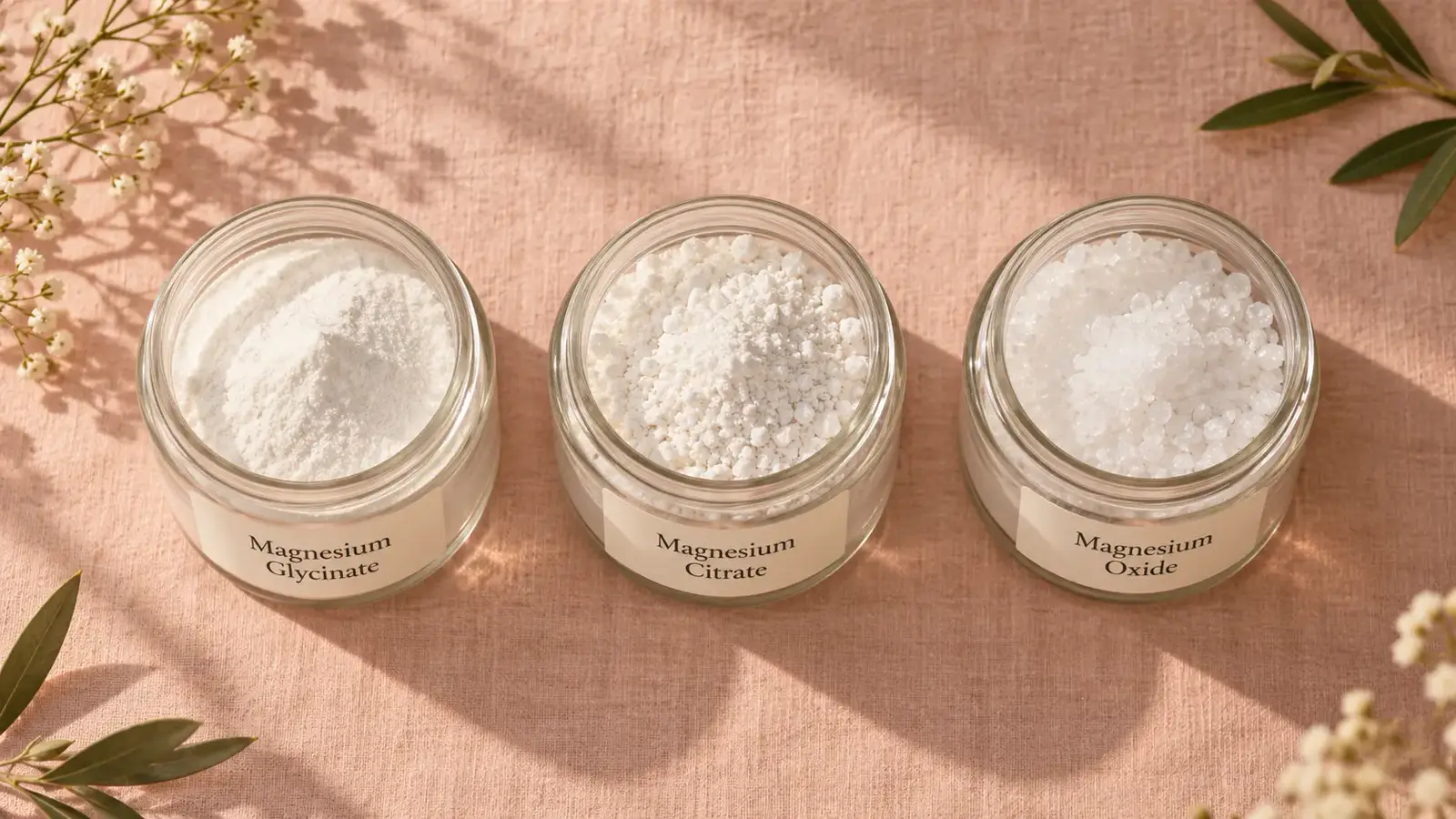
Magnesium Glycinate vs Citrate vs Oxide: Which One Actually Works?
By Flexies Team
If you've ever walked down the supplement aisle and felt your eyes glaze over at 'magnesium glycinate, citrate, oxide, threonate, malate'... same.
Here's the short version: the form on the label tells you what the magnesium is bonded to, and that bond decides where it ends up in your body and what it actually does for you. Pick wrong and you'll either get nothing, or end up in the bathroom.
Why the form matters more than the milligrams
Magnesium is a mineral, and minerals don't travel around the body on their own. They get bonded to something (usually an amino acid or a salt) and that 'something' decides how well your gut absorbs it.
A 400mg dose of magnesium oxide and a 200mg dose of magnesium glycinate can land you in completely different places. Higher number on the bottle is not the same as more magnesium getting into your cells.
Magnesium glycinate (or bisglycinate)
Best for: sleep, calm, evening wind-downs, anyone with a sensitive stomach.
Glycinate is magnesium bonded to glycine, an amino acid that's itself associated with restful sleep. It's well absorbed, gentle on the gut, and doesn't have the laxative effect that other forms can.
This is the form you'll see in most premium sleep supplements for a reason. If your goal is 'help me actually wind down at night', this is the one.
Magnesium citrate
Best for: occasional constipation, gentle digestive support.
Citrate is magnesium bonded to citric acid. It's absorbed reasonably well, but it has a mild laxative effect because it pulls water into the bowel. Some people love this. Others very much do not.
If your goal is digestion or you're someone who runs sluggish, this can be the right one. If your goal is sleep, this is probably not it.
Magnesium oxide
Best for: cheap multivitamins that want a magnesium claim on the label.
Oxide is cheap and contains a high percentage of elemental magnesium on paper, but absorption is notoriously poor. Studies put it at roughly 4% bioavailability in some setups. Most of it passes straight through you, which is also why it can cause loose bowels.
If your magnesium supplement says 'oxide' and your goal is sleep, calm, or muscle recovery, you're paying for something that's mostly not landing.
The other forms you might see
Magnesium malate: bonded to malic acid, sometimes used for daytime energy and muscle support.
Magnesium threonate: more expensive, marketed for cognitive support. The research is interesting but early.
Magnesium taurate: bonded to taurine, sometimes used for heart and nervous system support.
For most everyday goals (sleep, calm, muscle recovery, just topping up a low intake), glycinate is the safest, gentlest, best-absorbed pick.
How magnesium sits in our Sleep Gummies
Our Wind Down Sleep Gummies use 100mg of magnesium per serve, sitting alongside 200mg of L-Theanine, GABA, glycine, ashwagandha, and a botanical blend of valerian, chamomile and passionflower.
It's intentionally a gentle, evening-friendly dose, not a megadose. Magnesium does the muscle-relaxation work, while the rest of the stack supports the calm headspace and wind-down ritual. The whole formula is melatonin-free.
If you're already on a separate magnesium powder, you don't need to stop, the dose here is on the lower, supportive end and plays nicely alongside.
pairs well with
Frequently Asked Questions
What's the best magnesium for sleep?
Magnesium glycinate (sometimes labelled bisglycinate). It's well absorbed, gentle on the gut, and bonded to glycine, an amino acid associated with restful sleep.
Will magnesium oxide work for sleep?
Probably not noticeably. Oxide is poorly absorbed and is more associated with a laxative effect than a calming one. If sleep is your goal, glycinate is the smarter pick.
Can I take magnesium glycinate every day?
For most healthy adults, yes. Follow the directions on the pack. If you're pregnant, breastfeeding, on medication, or managing a kidney condition, check in with your GP first.
How much magnesium is in Flexies Sleep Gummies?
100mg of magnesium per 2-gummy serve, layered with 200mg L-Theanine, GABA, glycine, ashwagandha, valerian, chamomile and passionflower. A supportive evening dose, not a single-ingredient magnesium product.
Can I take magnesium gummies with a magnesium powder?
Yes, they play nicely together. The 100mg dose in our Sleep Gummies is intentionally gentle, so it sits comfortably alongside a separate powder if you already use one.
Related Reading

How to Reduce PMS Symptoms Naturally
Cramps, mood swings, bloating... PMS is not fun. But there are genuinely helpful things you can do to take the edge off naturally.

Beauty From Within: Building Your Daily Supplement Routine
The best beauty routine isn't just what you put on your skin. Here's how to build a daily supplement stack for hair, skin, and nails.