Sea Moss vs Spirulina: Which Superfood Is Right for You?
By Flexies Team
Sea moss and spirulina both sit firmly in the 'superfood' category, and both have loyal followings. But when you actually look at what they contain and what they do, they're surprisingly different.
This isn't a 'one is better than the other' situation. They serve different nutritional purposes, and the right choice depends on what your body actually needs. Let's break it down.
What they are
Sea moss (Chondrus crispus) is a red algae that grows along Atlantic coastlines. It's been used in Caribbean and Irish traditional food for centuries, primarily as a mineral-rich food source.
Spirulina is a blue-green cyanobacterium (technically not a plant, but we'll forgive the 'superfood' label). It grows in freshwater and has been consumed since Aztec times. It's one of the most protein-dense foods on the planet.
So right off the bat, they're from completely different environments: sea moss from the ocean, spirulina from freshwater. That difference matters for their nutrient profiles.
Mineral profile: where sea moss stands out
Sea moss is naturally rich in minerals, including iodine, iron, calcium, magnesium, zinc and selenium, plus a range of trace minerals that are hard to find in a typical diet.
Its mineral breadth is genuinely unusual. Most supplements give you 10 to 15 nutrients. Sea moss naturally contains a much wider spread. This is why it's often compared to a whole-food multivitamin.
If your primary goal is broad mineral support, filling nutritional gaps, or supporting your body's baseline systems (energy metabolism, skin health, digestion), sea moss has the edge.
Protein and antioxidants: where spirulina stands out
Spirulina is roughly 60 to 70% protein by weight, which is extraordinary for a plant-based source. It also contains all essential amino acids, making it a complete protein.
It's also rich in phycocyanin, a blue pigment with strong antioxidant properties. Spirulina tends to be higher in B12 (though the bioavailability is debated) and GLA (gamma-linolenic acid).
If your primary goal is plant-based protein, antioxidant support, or supporting recovery after exercise, spirulina brings something sea moss doesn't.
Can you take both?
Absolutely. Sea moss and spirulina complement each other really well. Sea moss covers the mineral side, while spirulina brings protein and antioxidants. There's minimal overlap in what they provide.
A lot of wellness enthusiasts stack both alongside other supplements like mushroom gummies or probiotics. There's no interaction concern, and the combined nutritional coverage is genuinely impressive.
If you had to choose one, think about what you're actually lacking. Feeling run down and mineral-depleted? Sea moss. Need more plant protein and antioxidant support? Spirulina.
Format and taste: the practical stuff
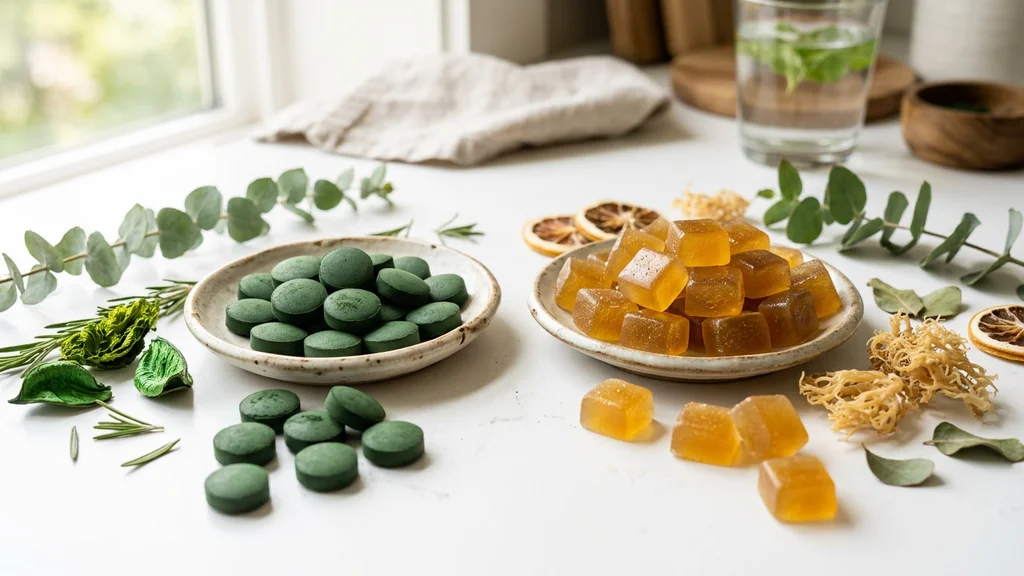
Raw spirulina powder has a very distinct, earthy, pond-water taste that many people struggle with. Spirulina tablets solve this but often require taking 6 to 10 per day.
Sea moss gel has a mild, almost neutral taste but requires refrigeration and has a short shelf life. Sea moss gummies (like ours) solve the convenience problem entirely: consistent dosing, good taste, shelf stable, and no fridge needed.
Whichever you choose, the format you'll actually take consistently matters more than which one is theoretically 'better'.
pairs well with
Frequently Asked Questions
Is sea moss or spirulina better for energy?
Sea moss provides a broader mineral base (including iron and iodine) that supports energy metabolism.
Spirulina's protein content can support sustained energy, but for mineral-driven fatigue, sea moss is the stronger choice.
Can I take sea moss and spirulina together?
Yes. They have minimal nutrient overlap and complement each other well. Sea moss covers minerals while spirulina brings protein and antioxidants.
Which is better for skin?
Both contribute to skin health through different pathways.
Sea moss provides minerals like zinc and selenium that support skin maintenance. Spirulina's antioxidants support skin protection. For skin specifically, pairing either with a dedicated beauty supplement will give you better results.
Is spirulina a good source of B12?
Spirulina contains B12 analogues, but their bioavailability in humans is debated. If B12 is a priority (especially for vegans), a dedicated B12 supplement is more reliable.
Related Reading

Sea Moss for Energy: Does It Actually Work?
Sea moss has been trending as a natural energy supporter. But does it actually live up to the hype? We break down the minerals, the research, and what to expect.
Sea Moss Benefits for Women: What's the Hype About?
Sea moss went from Caribbean kitchen staple to wellness superstar. But does it live up to the hype? Here's what women should know.
Sea Moss vs Multivitamin: Which One Should You Take?
Sea moss has been called 'nature's multivitamin' but is it actually better than a traditional multi? Here's an honest comparison.